Latest Posts

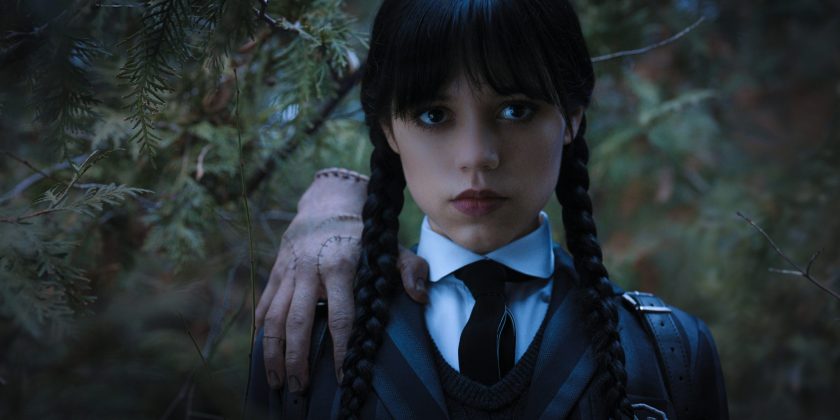
Wednesday. (L to R) Thing, Jenna Ortega as Wednesday Addams in episode 104 of Wednesday. Cr. Courtesy of Netflix © 2022

A New Woe

or, How Netflix’s Wednesday isn’t like the other Addams Family stories.

Preface: I ADORE the Addams family. I always have. Even as a child, I loved the Addams family (and spurned the Munsters). And I was still a teenager when I discovered the darkly morbid comics of Charles Addams, the cartoonist who created the characters who would eventually bear his name. (Fun fact: the original cartoon characters had no names, being typically drawn in one panel vignettes that simply didn’t need such to land the punchline.)

Tl;dr — I just finished watching Wednesday, and I love it, but there’s a caveat, which I’ll get to later. I think Alfred Gough & Miles Millar did an extraordinary job of walking the fine line between the strange and often disturbing humor of this world. In fact, there are elements of this show that directly play off details from the original comic strip, from the look of Gomez Addams to Mrs. Weems (originally the family babysitter) with remarkable faithfulness.

If I’m being honest, I have very little to complain about.

But since that’s never stopped me before, here we go:

  • Given that the Hulk-like transformation of a certain character absolutely shreds clothing, how did no one notice? Also, screw changing into a monster, it’s their quick-change ability that’s the real super power here.
  • “Goody” is a title, damn it. Short for “Goodwife” and used for older married women of commoner status in Puritan society. This is like naming your daughter “Auntie.” It makes no sense unless used as an example of Addams Family whimsy, in which case, I’d have appreciated a lamp shading of that fact.
  • Hunter Doohan looks every bit of his 28 years, and fat chance I’m going to sign off on him being a teenager. As a result, it makes his character’s attempts to romance Wednesday creepy af, and I’m 95% certain that wasn’t intended.
  • That is not how emojis work.

That’s it. Those are my complaints.

So let’s talk about that caveat: the show’s relationship with humor. Ironically enough, also the show’s relationship with violence, death, and empathy.

Basically, let’s talk about murder. (Please note, I am not including the 2019 animated cartoon in any of this discussion.)

This isn’t a critique of Wednesday, the TV series, because I actually think it attempts to patch a flaw I’ve always felt existed within the Addams Family. It doesn’t always do this successfully, and in fact it often dips into narrative dissonance in the attempt, but the fact that it tries at all is really interesting.

Here’s the problem: Death has no meaning in the Addams Family.

It’s not just that they’re psychopaths (although they are) but that death and violence is, literally, a joke.

I’ll use a scene that appears in both the original Charles Addams cartoon and in the first movie as an example: Morticia sees a knife in Wednesday’s hand, asks if that’s meant for Pugsley, and upon hearing ‘yes,’ upgrades the weapon to a significantly larger and more deadly cleaver before sending her daughter off to murder her son. Which is horrifying and grim and funny as hell. And yet, in all these “play” sessions (which mirror the equally violent rivalries between Gomez and his brother Fester), we never see either child with significant injuries. The intention of violence is shown. The consequences? Never. I’ve seen a lot of attempts to explain this, most of which amount to: they’re monsters and thus presumably either heal or are flat-out unkillable (this later seems unlikely given that Wednesday’s greatest ambition at one point was to be burned at the stake like her Great Aunt Calpurnia). But it’s fine! This is playtime, let’s pretend, and we laugh and take it that way. No permanent harm done, even if murder is the most popular topic of conversation at every Addams family meal.

Unfortunately, this excuse comes crashing to the ground when it collides with characters we know are not monsters. Characters whom we can’t convince ourselves just ‘got better’ off-camera.

This happens viscerally in Addams Family Values, when the children are sent to Camp Chippewa and end up making their own unique changes to the Thanksgiving play — which culminates in them literally burning Wednesday’s rival Amanda at the stake and roasting two camp counselors alive. Now, the camera cuts away before we know for certain that Wednesday puts the girl to the match, or that the counselors die in their own immolation, but there’s little reason to think this isn’t exactly what happens. And we know damn well that none of those three were unkillable, unlike the Addams family themselves. Does the FBI ever come knocking at the Addams family door sometime later, wanting to talk to Wednesday and Pugsley about a little light mass murder? No way to know. (I don’t assume the Wednesday TV series exists in the same continuity, and there was no sequel to Addams Family Values. RIP Raul Julia, you absolute legend.) Within the framework of this story, people were (probably) genuinely hurt and (likely) really died. The jokes land, but only because we could (and did) cut away and never, ever confirm what actually happened.

It’s a matter of timing. Everything about the humor of the Addams Family, from the original cartoons to the TV show and movies which followed, relied on perfect timing — being able to cut away from the story at just the right moment, leaving the grisly results to the imagination but never on the page or screen. Yes, the entire Addams family is gathered up on the roof to pour boiling oil on the very mortal Christmas carolers below, but as long as we don’t see the oil land, we can laugh.

Which brings us to Wednesday, where we can’t just cut away, because in a serial-format TV show, cutting away from a scene without ever explaining what happened is called a continuity error.

(Warning: lots of spoilers follow.)

Our story starts off when Wednesday is sent to boarding school after she introduces two bags of piranhas to the swim-team’s pool in revenge for their bullying of her brother. The scene is paced in perfect Addam’s family style: We have the intro, Wednesday’s sadistic glee as she watches the fish do their work, the captain of the swim team attempting to exit the pool just as the piranha reach him, red blooming in the pool. Cue camera cut-away just as he starts to scream.

We later learn that he lost a testicle. Presumably, he could have lost a lot more. Make no mistake, this is at least assault, probably attempted murder. Presumably the only reason Wednesday gets away with it is because she successfully committed a crime too weird for the police to want to write up. Mostly, it’s still the classic Addams Family joke, just one with a little more follow-up than is typical.

But as a result, Wednesday is sent to her parents’ old boarding school, The Nevermore Academy, where all the weird monsters that live in the greater Addams family universe are finally given a name: Outcasts. And here, one of the major plot threads that runs through the early part of season one is the revelation that Wednesday’s father Gomez might be a murderer.

Um…and?

How is that remarkable? How is that news? Isn’t every member of the Addams family likely the perpetrator of at least a little homicide? It’s not even an ugly, sneaky kind of murder, but a crime of passion between two high school boys literally fighting over an equally young Morticia–a dramatic duel in the rain that is absolutely in Gomez’s wheelhouse.

And yet, Wednesday is upset by the idea that her father might be a murderer. Wednesday claims to be completely blase about murder, snarking when her mother tries to emphasize the seriousness of the piranha incident (“That boy’s family was going to file attempted murder charges. How would that have looked on your record?” Morticia says. To which her daughter replies, “Terrible. Everyone would know I failed to get the job done.”) but she also goes to great lengths to prove her father’s innocence. She’s clearly upset about his welfare, not his reputation. Likewise, her parents put off telling Wednesday the truth (that it was Morticia that killed the boy, and it was self-defence), because…

Because. Because Wednesday isn’t that kind of show. It can’t be.

The arrival of Wednesday to Nevermore is a watershed moment. Besides kicking off the plot, death suddenly matters. We can’t edit out consequence. And honestly? I kind of love that the writers largely don’t try (mostly–the Poe Cup race does have one classic Addams family homicide moment, as a treat).

The Addams family members continue to joke about and trivialize death the way they always have. When Wednesday confesses that there have been two murder attempts on her life in the week she’s been at the school, her father responds with nostalgic delight. They behave exactly the same way they always have, the same way we expect. They are completely faithful to the original material — or at least, they start off that way.

The brilliance of this show, imo, is that their joking is revealed to be a bluff, and reality calls them on it, hard. The sheriff is not willing to overlook Gomez’s crimes and yet when he discovers he’s wrong about them, is man enough to apologize (and Gomez is man enough to accept that apology). The other monsters going to Nevermore (even the ones who support Wednesday) are unwilling to be complicit in her plans to torture someone for information. Everyone is horrified when one of the students is seriously injured. Murder is bad. No one is killed as a punchline, and Wednesday, despite all her protests to the contrary, has just as strong an emotional response to her loved ones being injured as a “normal” person would. The show gleefully calls her on her bullshit, which results in her slowly realizing she cares (even if she’ll never admit it). By playing it absolutely straight, the writers have interjected a depth into the Addams Family I honestly wouldn’t have thought possible.

Part of this is accomplished by giving an usual amount of depth to the other characters. Bianca, a siren with mind-control powers who is set up early to be Wednesday’s rival, is not treated the way Amanda from the movies was, but is a real person with her very own real problems. When she and Wednesday finally reach an accord, it’s with no shift at all to Bianca’s core personality–a real rarity in these sorts of shows where the villain’s face turn often feels like they’ve been replaced with a doppelgänger. (Likewise, Wednesday’s growth arc is satisfying without feeling rushed or fake.) Enid? Oh, I could wax on about Enid, the bubbly dorm mate foil to Wednesday I absolutely ship (sorry, Xavier and Tyler). I expected her to be two-dimensional. She wasn’t. I could go on.

Nobody is just a joke, and as a result, neither are their deaths. Even the damn coroner, who we see on screen for approximately three minutes in total, gave me enough background and personality to feel genuinely sorry when I realized he’d been murdered.

People have real feelings, and Wednesday can hurt those feelings, and this too is a consequence that the writers don’t cut away from. I could still like Wednesday while simultaneously cheering when one of her friends finally gave her the verbal lashing her manipulative behavior so completely deserved. People are complicated.

The result of which is a show that I found far more interesting than my expectations led me to believe. I can only hope Alfred Gough & Miles Millar show as much care in season 2.

But I will definitely be watching it.

Baby Steps

(Or, creating a book using Agile, part 2)

So I meant to get this out at the beginning of the sprint…

Instead, I’m coming in at the end. That’s fine. Mostly.

Wait, do you know what I mean by sprint? Some of you will, but for the others…

In Agile, work is typically grouped into what’s called a ‘sprint.’ Now you may be familiar with the term ‘sprint’ as a short Pomodoro-esque writing session, but this is one case where the same term wears many hats. Here? It’s a nebulous but previously determined block of time. The vast majority of sprints are two weeks long, but I’ve seen sprints that are one week and sprints that are a month. Once you decide on a sprint length, you shouldn’t change it unless there’s a very good reason (it messes with the metrics).

I closed out the first sprint by checking on what I’d accomplished and what I hadn’t. I did not finish all my research (some of it required reaching people I just couldn’t locate) and I did not finish the outline. Well, I finished most of the outline. I also changed everyone’s names, oh, at least three times, as one does.

But back to the two-week sprint. Unless you’re Chuck Tingle or Dashiell Hammett, two weeks isn’t enough time to write a book. A month is iffy, no matter what Nanowrimo might say. But that’s okay. I’m going with the two-week cycle, and I’ll just take it as given that I am unlikely to have a finished product at the end. This is typically considered a ‘failed’ sprint, but again, we’re ignoring that. Writing a book is not the same as writing code, and I make the rules here.

So, two weeks. What can I get done in that time?

Let’s do some quick and easy math. Let’s be conservative and assume two thousand words a day. Let’s also assume a 100,000 word novel. So in fourteen days, I should theoretically have 28,000 words done (I’m a not doing that much this sprint, but that’s because I was still finishing up the story breakdown.) If I round down to 25,000 words a sprint, I should take four sprints to finish the first draft — 8 weeks. (It will probably be closer to 10 weeks.)

So we’re going to plan on the first draft (a milestone) being finished after five sprints, combined with that first planning sprint, for a grand total of 10 weeks. Since I started at the beginning of October, that means the end of December.

Omg, you say, that’s so fast!

Hold on.

This is less of a ‘first’ draft than what others might call a draft 0. It is very much me telling me the story, and is not fit for public consumption. Not just spelling and grammatical errors, but massive plot holes, inconsistencies, and widowed/orphaned plot lines will riddle this document. I already have one of these: I started the book with a scene which I immediately decided I hated, and which fit neither the character involved nor how I wanted her to be perceived by readers. So I want to change it completely, and I’ve already figured out how.

I’m just not doing it yet. That will be on the next draft.

It’s also important to note that 2k per day is me being conservative. When I really get going, I easily write 5k a day. And that’s good, because the problem holding me back under such circumstances has never been how fast I type but how fast I think: the specific plot basics of who does what and when take as much or more time to figure out than the writing itself. Should I end up working faster than 2k, I’ll adjust the schedule to match.

As it currently stands, I have a lot of what I call [brackets]. These are placeholders. Not names so much this time, but definitely plot elements. With The Ruin of Kings, I had a chapter that consisted entirely of [training montage] right up until the last draft I sent my agent. I just didn’t have a clue how to write that bit in a way I didn’t find incredibly boring. So I skipped it until I figured out what I was doing there. (It ended up being one of my favorite chapters.)

So, as we get ready to kick-start Nanowrimo month, remember that it’s all about baby steps.

Next time I’ll break down some of the crunchier bits of what tracking a sprint actually looks like (because I realize this one was heavy on commentary and light on actual how-to advice).

Read for Pixels Charity Event 2022 – Hey, Wanna Do Some Early Christmas Shopping?

Earlier this year, I was asked to take part in the Read for Pixels fundraiser, which benefits The Pixel Project.

The name “The Pixel Project” might make you inclined to think it’s about video games, but no. The Pixel Project is a non-profit organization dedicated to stopping violence against women. I am rather automatically predisposed toward the cause: mostly because I’ve been the victim of violence against women myself.

That feels weird to say, by the way. I think of my mother as the one who was targeted for violence, but I was also in the household, and I was also a target for my stepfather’s drunken rages. I was spared the majority of the physical abuse; the emotional scars remain.

This is one of those things that we as a society rarely talk about. We are not encouraged to talk about it. As such, so many women don’t understand what their options are, or how to escape a potentially life-threatening situation. That’s what The Pixel Project does: raise awareness. It’s good work.

Read for Pixels (The Fundraiser)

September is a fundraising month for the nonprofit group. When they told me they were trying to raise $5,000, I thought, “That’s great! They’ll raise that much money in no time!”

Friends, they didn’t.

To tell you the truth, I’m shocked. This seemed like a no-brainer to me. It’s not like the typical fundraiser auction. All you have to do is follow this link. You find something you like? First come, first served. Critiques, zoom calls, signed books, 1-on-1 sessions with major authors! (Sorry, but my own offerings have already been purchased.)

The Pixel Project has expanded out their fundraiser, so it now lasts until the end of October. That means you still have a chance to grab some of this stuff for yourself. Or you can always just drop off a small donation. Anything is appreciated.

It really doesn’t have to be this way.

Interested in checking out The Pixel Project’s anti-violence against women work? Visit them at https://www.thepixelproject.net/

The Importance of Checking Boxes

(Or: How I start a novel, Agile-style.)

So as I am hitting the ‘send’ button on sending two manuscripts off to my agent, I am naturally planning my next book. As one does. And I thought it might be interesting, if not helpful, to go over what I do and why.

Because at heart, I will always be a project manager.

I have to do this because I have ADHD. However, long before I was diagnosed with such, I’d learned coping mechanisms that allow me to function to varying degrees of success. (My closets are still filled with craft projects I have thrown myself into with obsessive gusto and then abandoned several weeks later, but at least I know why that happens now.)

One of the best methods (for me) is the satisfying feeling of accomplishment that comes from checking a box as ‘done.’ (Similarly, moving a task from column A to column B.) If I can break it down into a small task and put it on a list, there is a much, much better chance I might actually do it. Not perfect, but better.

If it’s a big task though, I’ll put it off.

And put it off.

And put it off.

Very often, it will be put off indefinitely until A) I’m slammed against a deadline and Must Get It Done, B) the matter is moot for various reasons, or C) it’s shoved into a closet and forgotten.

Now you may have noticed that books are a big, very big, enormous task. So much so that my family and friends and oh, just about everyone who’d ever known me were shocked beyond measure when I began finishing books. But the way I approach writing books is fundamentally different to the way I approach, say, illuminated calligraphy.

Books are giant elephants, so huge that to finish one, I found myself resorting to the methods I used to organize other unspeakably ‘big’ projects like computer programs or video games—Agile.

Let’s break here to cover a few buzz words. “Agile” is a project management philosophy that became hugely popular in the beginning of the 21st century, primarily in software development groups (for which it was created). It is typically compared to “Waterfall”-style management systems, in which the emphasis is finishing each step to completion before moving on to the next step in a chain that will, hopefully, one day end with a finished product. Agile, on the other hand, asks for a ‘complete’ program/feature/story as quickly as possible. A ‘finished’ product is developed early, but at a crude level of quality, and must be subsequently refined over various iterations/revisions.

In the world of writing novels, Waterfall translates beautifully to a ‘one pass’ approach, in which the author writes, edits, and polishes each scene/chapter before moving on to the next. Agile, in contrast, is the ‘you can’t edit a blank page’ style of book writing, where the important thing is to get something down on paper, no matter how sloppy, so you can fix it during revisions.

(There are plenty of places where Waterfall is objectively the better way to do things, by the way. Can you imagine blodging together a house and then trying to go back and iteratively improve the foundations? Yikes. Any job that requires careful precision and lacks the ability to correct mistakes without literally starting over is not a good candidate for an Agile workflow.)

Even in the world of books, however, I’m not saying that one is better than the other. I am saying that I’ve never managed to finish a manuscript using a Waterfall-style method, and have finished eleven manuscripts using something more Agile. (I know people who successfully use a Waterfall-style method when they write, and their books are beautiful works of art that make me grind my teeth with envy, so this is very much a case of doing what’s best for you.)

It’s my opinion that one of the main benefits of Agile is that it addresses Parkinson’s Law: work expands to fill the time available for its completion. The more time you give yourself to finish a project, the more time it will take to finish that project, regardless of how much time it should have taken. There are multiple reasons Waterfall is a bad system for me when it comes to writing, but possibly the biggest is this. Lacking a definite deadline, it’s extremely easy to be distracted by all manner of things. Life. Research. Twitter. Everyone wants a piece of a writer’s time. Suddenly that deadline is looming and I find myself contemplating a Dashiell Hammett-style weekend writing marathon.

Because Waterfall’s method emphasizes ‘finish each step before I continue to the next’ it’s very easy to find myself locked into a spiral of endless noodling too, where I never get beyond Chapter 1 because that first page isn’t perfect yet. Or reach the three-fourths mark of the book and realize I goofed about something major in chapter 2 and now must rewrite it all. Additionally, because even a chapter can come off as ‘something too big to do today,’ finding another excuse to procrastinate. And if a writer hasn’t done a good job of establishing deadlines, it’s all too easy to get caught in a writing loop where the answer to ‘when will X be finished?’ is…never.

So, Agile is all about tricking the brain. No, I do not have ten months or one year or as long as I want to finish a book. I have two weeks to finish the plot, character development, and create a basic outline for my novel, as well as answer some fundamental questions about style, goals, needs, etc. I use a project management program (sadly, not one I can recommend, as it’s no longer available for free). Each of these needs is broken down into tasks and if any task looks like it will take more than a day, I try to break it down into smaller tasks.

And then I check off boxes. (Or move a task from Column A to Column B, but you get the idea.) There is no elephant. There’s just this small, two-week project that is absolutely attainable. Does it have to be perfect? No. Can quite a lot of it be blatant placeholders? Yes.

Which brings me to one of the other advantages of Agile: failing early.

That may not seem like an advantage, but one of the gutting things about being a writer is the fact that it’s entirely possible to spend months, if not years, of your life writing a piece that doesn’t work. Often, the reason it doesn’t work is because of a flaw in the initial premise, something so intrinsic that no amount of copy edits will fix the problem. But part of the goal with Agile is to put you in a position to see a top-down view of your work as fast as humanly possible in order to fix any problems as fast as humanly possible. Before you’ve lost years of your life creating something you won’t use. Failing early is much better than failing late. So the earlier I can put together a summary, an outline, something that roughs out the basic story so I can show it to my husband, to friends, to other writers, the earlier I can act on that feedback.

It all starts with the basic plot and summary. So that’s what I’m doing today—creating that list of the work I will need to do in the next two weeks. I should add here that I already have a novel concept and idea in mind. Had that not been the case, that would’ve come before this step, but as it happens, I have a rather long list of ‘what next’ projects I’ve been thinking about for years.

Coming up, I’ll cover what happens next and why that outline I’m going to create in Step 1 is both vitally important and also doesn’t mean a damn thing.

Wandering in with a Starbuck’s Cup

Hey, what’s up?

So…it’s been uh *checks the calendar* three years.

Wow, it really has been three years. Okay…so I guess I haven’t been updating, have I? All right, let’s do this. What’s been going on in my life?

The obvious answer, as it has been the obvious answer for everything, is “living in the age of active pandemic.” Which has been heartbreaking on many levels, not least of which because it turns out that ‘I told you so’ stops being a lot of fun when millions of people have died.

On a personal level? I finished a five-book epic fantasy series for Tor Books. Yeah, that’s right. That baby is DONE. The last book in the series, The Discord of Gods, comes out on April 26th (which means you have not missed your chance to pre-order!) It’s a tremendous accomplishment and a strange feeling of loss all the same time. Because it’s not just that I’ve written four books in the last three years (each over 200,000 words), but I have been involved with various characters, concepts and bits of world-building that would become A Chorus of Dragons for slightly longer than that.

Say, thirty-five years. And now it’s done.

If you’ve ever wondered why authors go back to a world that they’ve written a series in, believe me when I say it’s not just for another paycheck. It’s because you start to miss it. The characters, the places, the concepts. I’m too new off the high of finishing to be there yet, but I can already see the writing on that wall.

Naturally, I have started on my next book. New world, new characters, new setting. It’s wonderful to be able to really stretch my world-building legs and make something new. I really can’t wait to introduce you to this world. It’s a lot of fun. By which I mean incredibly dangerous and full of stuff that would love to kill my main character. As is tradition.

I hope you’ll join me. And in the meantime, I’m going to try to keep updating this site (Note the “try” here) and keep telling stories. That said, what do you want me to talk about? I’m officially taking requests (leave a comment).

Love you all. Stay safe out there.

WorldCon Schedule

Yes, I’ll be in Dublin in just over a week!

So a few quick notes about when and where you can expect to find me:

Introduction to grimdark

Format: Panel

16 Aug 2019, Friday 18:00 – 18:50, Wicklow Hall-1 (CCD)

Grimdark is a fantasy subgenre defined, amongst other things, by its cynical outlook and flawed protagonists. The term was originally pejorative, stemming from the Warhammer 40,000 description: ‘In the grim darkness of the far future there is only war’ – but many authors have turned the insult around and claimed it as their own. The panel will offer a brief introduction to the history and tropes of grimdark fantasy as well as reading recommendations.

PLEASE NOTE: I’ve been told the printed convention schedule has me listed for a Beer Meet up at 21:00. THIS IS NOT CORRECT. Sorry, but there was a scheduling conflict. I’ll let people know if this is moved to another time.

Koffeeklatch

17 Aug 2019, Saturday 12:00-12:50

Sign up in advance required. Drink coffee and ask if that certain favorite character of yours is REALLY dead. (Or any other questions you might have.)

Who did what best?

Format: Panel

17 Aug 2019, Saturday 16:30 – 17:20, Odeon 3 (Point Square Dublin)

We look at the elements of images that define the tropes of sci-fi and fantasy, and we ask what artists did the best versions. Expect some arguments…

Autographs: Monday at 10:00

Format: Autographing

19 Aug 2019, Monday 10:00 – 10:50, Level 4 Foyer (CCD)

The Name of All Things

So here’s an excerpt and the cover reveal for the next book in A CHORUS OF DRAGONS. (Thank you, Barnes and Noble!)

Pre-orders are a go!

So while I had gone to sea and was thus incommunicado, I received a few comments on the blog that were interesting. So let me clarify a few things:

  1. Yes, we changed the name of the series from when it was originally announced. No, I can’t really discuss why. All I can say is that is was for legal rather than artistic reasons and honestly, that’s the end of that. It happens. Serendipitous, I actually like the new series name better, so sometimes we have, as Bob Ross liked to say, “happy accidents.” Unfortunately not everyone seems to have gotten the memo, so there are still the occasional references to the old series title lurking around on the internet. All we can do is keep asking them to update their information.
  2. The series is on a nine month release schedule. That means that, should everything go to plan, Tor will be releasing a book in the series every nine months or so. Two this year, one next year, two the year after that (again, if all goes to plan.) Is this stunningly ambitious? Yes. Is this going to kill me? Quite possibly, especially when combined with an aggressive convention and touring schedule (or heavens, production starting on the TV series.) This isn’t something being done trivially, and it has basically meant I have sacrificed all free time and all personal activities on the bonfire of this series until it is completed. Why did I decided to do it then? Because I happen to have the privilege of being able to work at this full time and because I do my best work when pushing myself to go as fast as possible.
  3. And on that last note, please be patient with me. It’s JUST me here. I don’t have an assistant or staff or anyone helping me. If I’m living here on the blog or on social media, I’m not writing, and nobody wants that. So if I don’t respond immediately, it’s probably not that I’m ignoring you. It’s far more likely I just haven’t remembered to check in.

Love you all! Now I’m back to finishing book 3.

The Tantalizing Promise of Hollywood

One of the things I’ve learned about the publishing process is that very often you cannot talk about your triumphs until months or even years later. Contracts might be signed, but announcements happen on a strict schedule. This business moves slowly…right up until it doesn’t.

Or, to put this more bluntly: The Ruin of Kings has been optioned to become a TV series.

But…what does that mean, you may ask? Good question. Truthfully, books are optioned all the time, and while it’s a lovely bonus to the author, it rarely results in, well, a TV series/movie/whatever. That’s because an option is just that — it’s a given studio paying a premium to have the option to develop a property. It’s not a guarantee that the studio will actually do so, only a guarantee that no one else can while the studio is making up its mind. Clearly I hope that in my case the studio WILL move forward, but I have to imagine every author with an optioned work feels exactly the same.

Still. This feels a bit like that first phone call with my agent (before he was my agent) when a possibility that had never before seemed practical or obtainable was suddenly a very real ‘this could happen.’ Likewise, this could happen. The Ruin of Kings could end up being developed as a TV series.

Excuse me. I need a moment to collect myself.

But will it happen? Impossible to know. I do know that I’m damn lucky to have gotten this far and I very much appreciate that.

I feel I should also point out that right now, I know as much as you do about how the TV show would move forward. I seriously mean that. Nothing beyond the option itself has been decided. And even when that changes, my involvement will be…let’s just say ‘advisory.’ I will say this: I respect that TV is a different medium from literature and has very different strengths. I wouldn’t expect the TV adaptation to be scene for scene from the book. I also really like the studio, Annapurna, who has bought the option. I feel confident they’re going to do an amazing job.

So, I have a book that is out in the public right now. The second book, The Name of All Things, comes out in late October. And I’m finishing up the untitled third book right now.

So I better get on that.

Hello Again

So, it’s been a while, hasn’t it? And boy, stuff has changed. My whole life has completely changed. I figure it’s a new year, so I might as well try to do at least the occasional blog update.

Where I currently stand: in less than 30 days, The Ruin of Kings will go on sale. It’s been an extraordinary journey. A few interesting stats, for folks playing the home game.

  • Number of queries submitted: 42 (should have been my clue)
  • Time from blind querying with my agent (yes, it was a blind query) to actually signing with him: 18 months. Please note this included time for Revise & Resubmit.
  • Time from selling the novel to publication: 21 months.

Add those together and you’ll quickly realize that reaching this stage has taken over three years from the point when an agent was actually interested until the book hits the shelves. Of course, it’s been far longer than that in terms of of all the agents who said no previously, the timing spent writing, etc. And it’s been an extremely busy three years — there was no stage the process was not extremely active. I was revising, people were editing, someone was proofing, creating layouts, sending out ARCs, marketing, designing the cover, recording the audio book.

In project management, one of the many things we seek to avoid is time where a project is in between owners. Where one person has finished working on it, but the other person/team hasn’t yet picked up and began doing their part. That’s waste. Ideally, a project is never idle. So it was interesting to me, as a producer, to see how rare it was for this project to be idle. It didn’t quite mesh with the public perception that traditional publishing is a slow gargantuan behemoth. Slow, yes, but not because of bogged down bureaucracies. Slow because people are taking a great deal of care. I hadn’t expected that.

The other thing I hadn’t quite been prepared for was just how busy I would be. Every author is different, but in my case, it turns out I’m one of those writers who need to spend a great deal of my time doing just that: writing. And while my editors adore that, it’s meant I’ve had to set some hard limits on my free time with friends, some of whom have been slow to understand that what they see as free time (the evenings) is in fact my work day.

This ride is still going, but every day I find myself thrilled, gratified, and humbled to see how the world I created is being embraced by the sff community. 2019 is going to be one hell of a year.

La Mort des Femmes

Okay, so let’s talk about “King Arthur: Legend of the Sword” the new Guy Ritchie movie. (Hint: That means there are spoilers below.) First, you should know that I am a bit of a King Arthur nerd. Not so much that I have a degree in it or anything, but enough that one of my most cherished possessions is a several hundred year old copy of Le Mort d’Arthur. King Arthur references (some subtle, some not) have made their way into every book I’ve ever written.

So I was hugely grateful when the movie opened on 300′ tall Helliphants (Worse than Oliphants, you see. Take THAT Peter Jackson!) and a text crawl informed me that obvious good guy Uther Pendragon was being attacked by the evil mage Mordred. OKAY, I thought. So this movie isn’t going to have a thing to do with any canonical telling of the King Arthur mythology. Cool. I know now. I can just lean back and enjoy the popcorn cheese of it all.

And honestly? I mostly did. It was a very enjoyable movie, with great patter, stunning special effects, and fantastic atmosphere. I will be buying the soundtrack as soon as possible, because it is SO GOOD. Guy Ritchie’s unique style of visual storytelling was, as always, a treat. I delighted in Guy Ritchie’s scoffing in the face of anyone suggesting a post-Roman England would need to be all white — multiple people of color are featured as major characters, without apology or explanation. (Indeed, one of the characters is named ‘Kung Fu George’ lest you miss that yes, he IS Chinese.)

But…

Oh man. BUT…the devil is in the details, isn’t it?

In this case, I knew I was going to be in trouble right from the start, when King Uthur woke up his wife, Queen Igraine (at least she has billing in the credits) with the greeting “Woman.” Woman? Queen of England and mother of his heir gets nothing more than ‘Woman?’

I suppose she didn’t really need a name, considering how quickly she dies.

Sadly, this was to be a precursor of things to come.

It gets worse.

So you see, this is a man’s movie. To be fair, that’s not unusual for Guy Ritchie, is it? His movie’s are men’s movies, movies where women exist only peripherally if at all, movies where men do manly things in a manly, violent way. And I’ve always been fine with that previously, mostly because I always had the sense that there was a keen sense of self-mockery going on. Guy Ritchie having a bit a laugh at all the toxic masculinity. Look, his previous movies always seemed to say: here’s a bunch of men behaving like men, oh and also being total idiots.

But this isn’t a movie where that sort of gritty buffoonery is appropriate, and it’s highlighted this fatal flaw. The women, Guy. What the fuck is your deal with women?

You see, very few of the female characters in this film are even dignified with a name, even though Arthur makes a point of introducing every single member of his all male crew. There are no women in his crew. Oh, that’s not quite true. He’s pimping the whores who raised him. And that’s what the vast majority of women are in this movie: whores. Whores or princesses or serving girls. Which honestly wouldn’t be a problem for me (I have no problem with any of those occupations) except that in this particular instance, whores or princesses or serving girls all seem to be synonyms for victim, for plot device, for that which must be sacrificed or endangered to move the story forward. Women rarely have agency of their own. They are there to be abused and rescued, or placed in peril and not rescued, or kidnapped and held for ransom, or…you get the idea.

There are two half-hearted exceptions to this: Maggie, a serving girl who is spying on the evil King Vortigern and The Mage, a mysterious French woman who has been sent by Merlin to help see Arthur made king. In Maggie’s case, she’s found out by Vortigern, who gloats that she is an excellent tool he will use her for his own ends (Hey, at least Vortigern lampshades his objectification. +10 points to Slitherin for refreshing honesty) before throwing her into a dungeon so everyone can forget about her for the rest of the movie.

The Mage is even worse, because even though she is a complete bad-ass who can control or summon multiple animals at once and cause all sorts of havoc and calamity when she’s rescuing Arthur, she becomes meek and vulnerable the moment one of the enemy soldiers brandishes a sharp knife in her vicinity. While I’m not against the idea of leaving her nameless (if the next movie doesn’t reveal that her real name is Guinevere, I’m going to be VERY surprised,) such a lack of name would be an appropriate contrast in a movie full of women who are ARE named, which is not the case here. Women were named in the credits, but other than Maggie and Lucy, I can’t remember who any of them were. Catia? Elsa? Kay? Maria?

I got nothing.

I wonder if those names belonged to King Vortigern’s wife and daughters, who were the most literal examples of objectification — you see, King Vortigern’s infernal power requires a sacrifice of something he loves, so he’s been rationing off the female members of his family as needed to feed a dark Cthulhian evil that is itself female and unnamed (in the credits they’re just called The Sirens.) And since Jude Law plays the part, and Jude Law is AMAZING, you can really FEEL the pain he’s going through, how much it hurts him. Oh, his tears! We’re supposed to feel sympathy you see…

Ugh.

So…to put it gently, I have mixed feelings about this film. There was a lot about it that I really loved, but sadly I’m not sure it’s enough to overcome the specter of the movie it might have been if it had remembered that women exist to be more than pawns.

That movie would have been awesome.