Latest Posts

Dark Son

Another reposted story from There by Candlelight:

——————————-

Marty Lucas walked into the principal’s office like he was about to receive an award, maybe something for bravery or valor — a citation for standing up to a bunch of punk bullies who thought they could get away with beating the candy out of every kid who was weaker, smaller and different from what they thought was ‘cool.’ The difference in posture was transforming: most of the kids who knew him in class wouldn’t have recognized him. Marty normally walked through the world with his head down, his hands stuffed into the pocket of his tan jacket, his eyes on the street, lost in his own thoughts. Today only, he walked like he owned the place, like he was a foot taller and could take on anyone who gave him the wrong look.

The school secretary, Nina Collington, looked distinctly bemused as she observed him. Nina was saucy looking redhead in her mid-thirties with short page-cut hair and mod cat’s eye glasses who has worked for the school for the past two years. Before that moment she couldn’t have told a soul what color the boy’s dark eyes were, no matter how many times he’d been sent to the office. Although only a Freshmen in High School, the stamp of troublemaker was already firmly attached to Marty Lucas. He had a talent for visits the administration building.

Nina sighed. “Mr. Lucas, may I say how disappointed I am to see you this morning?”

The young man pushed the dark curls out of his eyes and looked at her. He had a sly smile on his lips. “Sure, if you like.” He walked over closer to the table. “Are you going to?”

Nina paused with her hand on the phone to call the principal. “Am I going to what?”

“Say how disappointed you are to see me this morning?”

Nina narrowed her eyes at the young man. He wasn’t actually flirting with her, was he? She was used to that from seniors with no damn sense, but a Freshman? “Principal McIntyre is expecting you, I assume?”

The young man snickered. “Naw. I’m just here lurking in the hopes you’ll come to your senses and leave your husband for me.” He delivered the line more smoothly then most of the seniors would have.

Nina frowned at him. “You’re fourteen, Mr. Lucas.”

He grinned broadly. “I know, I know — you’re a little young for my tastes but just this once I’ll make an exception.”

Nina Collington pointed to the glass window that said ‘Principal’ on it in neat gold helvetica. “Through there, Mr. Lucas. Now.”

The young man drilled his fingers across the table as he passed her desk. “It’s okay, I know you’ll pine for me in the meantime.”

She stared after him and shook his head once the door was closed. “Puberty,” she said as if it were a curse word.

————————

Principal Fendleman was a middle-aged and thin man with an easy smile in spite of having to constantly deal with the eclectic demands of the School Council and local parents. He was popular with students on the grounds that he usually left them alone, but there were always exceptions. He was leaning back in a cheap Office Depot executive chair when Marty walked in, and quickly put aside the rubber band he was using to launch paperclips into a cup. “Marty, take a seat.”

The young man lost a lot of his swagger and replaced it with belligerence. He was pretty sure he knew how this was going to go, and he wasn’t here to receive any medals. He glanced down at the chair and snickered. “You sure? Won’t you need these later? What if another student wants to sit down?”

“Very funny, Marty.”

“I thought so.” After a bit of a cat staring contest, Marty finally sat down. He looked like it was an act of will not to put his feet up on the desk.

The principal looked at the young man for a moment. Marty was the sort of young man that schools feared; angry, bitter, quick to internalize that into a seething rage that sometimes has kids coming to school with guns in their backpacks. He was too smart for his own good, a bit of a geek, prone to being right and making sure everyone knew it. He was small and thin and looked sensitive.

Chum for the sharks, by all accounts.

Which is why the principal was more than a little baffled by the account sitting in his e-mail box. He moved the mouse to turn off the screen saver and looked at the brief account from one of the nurses. “Do you know what I asked you here, Marty?”

“Need someone to teach Chemistry?” Marty offered. He leaned forward and said in a conspiratorial voice, “Just between you and me, Mrs. Washington doesn’t know the difference between H2O and H2O2.” He gave Fendleman a ‘I told you so’ nod and then leaned back in the chair again as if he had just won a debate.

The principal frowned. “You’re here because four students were at the nurses’ station last night with bruises they claim you gave them in a fight.”

Marty Lucas didn’t hesitate. “Maybe they’re clumsy.”

“Clumsy.”

“Sure.” Marty jabbed his hands into his jacket pockets. “Fell down the stairs, ran into a doorknob. Clumsy.”

“Are you going to tell me what happened?”

There was silence as Marty examined the light fixtures overhead. He looked back down to the principal, giving Fendleman the distinct impression that Marty was managing to look down his nose at him. “That was a rhetorical question, wasn’t it?”

“Marty, I can’t help you if you won’t give me anything to work with.”

The teenager’s smile was amiable. “Great! You’re off the hook.”

“How do you figure?”

The smile faded. “I don’t need your help.”

Fendleman sighed. “I think you do. Marty, you’re a smart boy. All of your teachers see it, yet the only class you’re passing is shop. Since the start of the school year the only homework you’ve turned in was an oral book report.”

“That was a mistake.”

“It was?”

“Yeah, I didn’t realize it would count for credit; I thought Ms. Fredericks was asking for my opinion.” He then added in his defense. “I always score 100% on all my tests.”

“Homework is half of your passing grade.”

Marty’s stare was blank. He either didn’t seem to understand the consequences of that statement or, Fendleman thought more likely, he just didn’t care. Marty said, “And?”

“And? You’re failing your classes.” Fendleman studied the young man. “We offer grief counseling. I’d like to recommend it. You seem to be having a more difficult time adjusting than your brother.”

At the mention of Marty’s brother, the young man’s eyes grew hard and he looked away. He didn’t answer.

“Your mother’s death wasn’t so long ago. This can be difficult-”

“You think that’s what’s wrong with me? I’m torn up because my mom died in a car accident?” Marty looked at the principal with concept. “ You’ve got no idea.”

Fendleman ignored the tone for the moment. “It’s normal to go through a rough patch. Expected, even. This can’t be easy for your family.”

“People die.” The boy shrugged as if they were talking about some tragedy that took place on the other side of the planet, something that didn’t involve him personally at all. One leg was tapping on the ground in a nervous rap and he was no longer making eye contact with Fendleman.

“She was your mother.”

The boy looked over then. He locked stares with the principal. Fendleman couldn’t recall the last time he’d seen anyone with eyes so…dark. He couldn’t see where the pupil stopped and the iris began. Looking into Marty’s eyes was like looking into nothing, in a great endless black…

“Everything dies,” Marty said, his voice little louder than a whisper.

Fendleman broke off the stare that time, saying nothing, wiping his brow as he realized he had broken out in a cold sweat. It was cold in the office too, almost meat-locker cold. He could almost imagine his breath would frost the air.

“Why don’t you tell me what happened with those four boys?” The principal asked, eager for a change of subject, suddenly feeling ill at ease and out of control. A fourteen-year-old boy wasn’t supposed to get the better of him like this. In twenty years at the school, no one ever had before.

Marty smirked, breaking the mood. “We’re back on this again?”

“It’s the whole reason you’re in my office. What happened? Why did you attack them?” Fendleman didn’t stop to consider how insane that notion was. A boy like Marty didn’t attack four older boys. It just didn’t happen, or if it did, the boy could be reliably expected to have the stuffing beat out of him, left sobbing in a bathroom with a wedgie and toilet water soaking his hair.

Marty seemed to find the idea equally ridiculous and he scowled. “Oh yeah, because when I pick a fight, I make damn sure I’m outnumbered four-to-one to make sure the other guys stand a chance.”

“And yet, you’re not injured. They are. How do you explain that?”

“It’s my healing factor.” Marty wasn’t bothering to hide his sarcasm. “So it’s my fault they can’t throw a punch? Maybe if Rob and his buddies spent more time in the gym and less timing boning the cheerleaders they wouldn’t have this kind of problem.”

Fendleman rubbed his forehead. He felt tired. He felt old. There was something going on here he didn’t understand. Was Marty covering for someone else? But if he was, why hadn’t the other students mentioned it? They had all been explicitly clear that their attacker was Marty. Only Marty. It made no sense. “For all I know, you attacked one of them when he was by himself and his friends showed up to defend him.”

The dark-haired boy smirked. “I guess they didn’t do a very good job then, did they?”

“You’re not helping your case any.”

Marty’s stare was cold. “Not trying to.”

Fendleman inhaled deeply. “Marty, you leave me no choice. Your father will be called to pick you up.”

Only then did a look of confusion steal over the boy’s face. “Pick me up? For detention?”

“No, for your expulsion. Fighting is strictly against school policy. I might have been willing to look the other way if you had some kind of explanation for what happened — four against one are not nice odds — but you clearly have no intention of cooperating in any way. Your attitude is belligerent and rebellious and you clearly cannot control your temper. This is not the first incident and you are unwilling to make any effort to improve your behavior. Thus, you’re officially no longer our problem. Goodbye, Mr. Lucas. You know the way out.”

The aggressive, superior look the young man had worn all through their meeting crumpled in front of Fendleman’s eyes. He looked alone and lost and defeated. So intense was the expression that Fendleman wanted to change his mind, wanted to tell him it was all a misunderstanding, but the next moment, Marty’s expression hardened. That moment of vulnerability was past, and Marty looked at Fendleman with such malice and hate that the principal found his breath trapped in his throat as he flinched.

He only realized when Marty left, slamming the door behind him, and Fendleman remembered to breath.

——————————-

Marty had walked into the administration building like a man about to receive a medal, but he left it like a man sentenced to the chair. The role was only reinforced when he saw his brother Steve waiting for him outside.

Steve never really had any of Marty’s problems. He was a popular kid who did well enough at school to be on the honor’s list but not so well that he came off as a nerd. He had been in football since elementary school and it was taken as granted by virtually everyone who knew him that he’d be on the football team in High School and he’d probably end up as a quarterback one day, maybe even go college and later, pro. He was already tall and broad-shouldered, with golden blond hair and pure blue eyes. He was popular and easy to like and made friends almost effortlessly.

The punch line to that joke was that they were twins.

“You okay?”

Marty kept walking, and Steve fell in next to him, unwilling to let his brother go without wresting every detail of his humiliation. No doubt he’d already heard the rumors of Marty’s fight and was just dying to find out exactly how bad the punishment would be.

“Hey, I’m talking to you.”

Marty stopped on the sidewalk. “They kicked me out of school.”

Steve may have wanted to mock another round of detention, maybe even rub Marty’s nose in how bad he was going to ‘get it’ from dad for a few days’ suspension, play the martyr as he offered to collect homework he knew Marty would ignore and no doubt tell everyone at school what a chore it was to put with his brother’s rebellious behavior, but he hadn’t been expecting this – truthfully, it almost made the moment worth it. Steve’s eyes widened and he blinked at his brother in surprise. “What?”

Marty started walking again, hands jammed in his pockets, shoulder’s hunched. “You heard me.”

He heard footsteps as Steve ran up behind him to catch up. “But I don’t understand! You’ve gotten into fights before. Hell, you blew up the chemistry lab! They never expelled you.”

“This time was different. Lucky me.” He glanced over sullenly. “I swear the chemistry lab was an accident.”

“Dad’s going to shit.”

Marty’s lip curled. “Dad’s going to say ‘Why am I not surprised?’ and then order me to help him out in the shop. It’s what he wants, anyway.”

“You can’t just quit school.” Steve made it sound like it was basically unthinkable, like Marty has just suggested it was possible to ignore gravity.

The darker brother shrugged. “What do I need school for anyway? I know more than any of the science teachers there. I know more than any of the math teachers there. I just know more than they do.” His voice took on an angry cant at the end.

“Marty—“

Marty whirled on his brother. “Why do I know more than them? Nobody taught me calculus or chemistry. I just know it! It’s not supposed to work that way!”

Steve’s jaw worked silently as he regarded his brother. “I think it’s like the other stuff,” he finally said. “What we can do.” He shook his head then. “But you’ve got to learn to control yourself.”

“I did,” Marty sneered. “You know damn well that if I wasn’t in control, Rob and his bratty friends would be corpses right now.”

“You don’t mean that.”

“Oh I do.” Marty took a deep breath. “It would have been easy.” He waved his hand and a layer of frost and ice crystal began to form on his fingertips. The air around them grew colder and there was a sense of darkness.

Steve put his hand over Marty’s. He could feel the heat from Steve’s hand, melting the ice so it dripped down to the sidewalk as water drops. “Stop it,” Steve hissed. “Anyone could see us right now.”

“ Aren’t you tired of hiding?” Marty said then. “ Aren’t you tired of pretending to fit in when we don’t? We’re not like them!” He jerked his hand away from his brother and made a dismissive gesture towards the school he’d only been at for a few months but had already come to despise.

“Hiding? Is that what you call what you do?” Steve looked disgusted. “Because you’re not trying very hard.”

“Why would you want to?” Marty stepped close and lowered his voice, so at least his brother couldn’t say people would hear them. “You care so much what people think about you, but if they knew what you could do, if they really understood, they would run screaming. They would hate you. Why can’t you see that?”

Steve just stared. The horror behind his eyes was all too obvious, and after a brief pause Marty couldn’t stand it anymore. He turned from his brother, jammed his hands into his pockets, and began walking to where there father would pick them both up.

On the Road

Bring me that horizon.

Bring me that horizon.

An essay worth reading by Vanessa Vaselka. [Edited to add: Read this piece too. I think I love this woman.]

I remember when I was twenty-one, and working as a graphic artists for a newspaper in Los Angeles, two of my female co-workers left for a year to travel around the world together. It was not a good time for American women to be traveling around the world, but then again, I suppose one can argue it has rarely ever been. There’s always some reason it’s safer to stay at home. I was jealous of their bravery and their financial means (although they were not traveling in anything like style — this was $5 a day hitchhiking stuff they would be undertaking.) I was astounded that they could want to do this. Weren’t they scared? What if something should happen? Were they really going to hike through India? China?

The same imagination which is so beneficial to me as a writer also would have tied me up in anxious knots about such a journey.

A few years later, I worked for a woman named Stephanie who had, years before, traveled across the length of Africa with several friends in a baby blue truck. It was not a good time to be traveling Africa, but then it has rarely ever been. Stephanie had explained to me that, since she was a New Zealander, such behavior was customary and expected. Insane, but a particular kind of insanity in which New Zealanders take great pride, the same sort of thing that has them running with the bulls in Spain or keeps them skiing on the side of a volcano that’s in the process of erupting. I was shocked and inspired by her stories of her travels, by her passion for adventure, her daring to see what was over the next hill.

I could not help but feel that these were women who had somehow been born with an instruction manual, who knew how to live a life, who had, to use a metaphor more typically reserved for men, well and truly sewn their oats. They adventured, and I can only hold them in the highest admiration for doing so.

Back to Vanessa’s essay, which makes some rather extraordinary points about the reality that we make for ourselves through our modern literary work. You don’t have to agree with every point she makes, but it’s difficult to argue that we have a wealth of literary fiction examples when it comes to the women finding themselves on the road. A woman hitchhiking can be likened to the couple having sex in a horror movie — she’s going to come to a bad end, and most people will think she deserved it for being so foolish. What was she even thinking? Was she thinking? The idea of the quest is unrelentingly male. I can count on one hand the number of examples that I can think of where a female was the one so adventuring, and Vanessa names every single one of those examples as well. I want to have a knee-jerk response to this. I want to say she’s wrong. Of course a woman can do all those things! (See above examples, for instance. In fact, my own experience has no male counterparts.) But the lack of story, the lack of literary example, leads me to the same conclusion as Venessa Vaselka: that a case can be made that our collective subconscious believes a woman’s place is in the home. If we thought women should be out on the road, we’d write about them — well, we’d write about them as something other than victims to be raped, killed and dumped on the side of the freeway.

I’m not quite sure what to make of this. I certainly don’t have anything like an easy answer. I don’t think she’s wrong, but I don’t know that she’s wholly right either. I think any hitchhiker or traveler, male or female, encounters a significant amount of risk. Male hitchhikers are raped and killed too, but maybe we shake our heads less and don’t act like they were asking for it by the mere fact that they were hitchhiking. A woman on the road isn’t romanticized the same way. She is not having an adventure; she is in jeopardy. I acknowledge her point. I also hate her point, even if I personally would never hitchhike and have never gone off on wild explorations. I want my fellow sisters to be able to without everyone assuming they must be crazy and broken, come from battered families and are battling off drug abuse and prostitution.

If there is anything I have learned from my own experience, and the author of this story is right to point this out in my opinion, its that through our literature and writing, we truly do shape reality. How we feel, how we see the universe, how we expect people to behave — all of that is nudged, word by word, through the stories we create and share among one another. So if there’s a lack of this kind of story and its subsequent effect on our perspective, there is also a solution. Write.

©2013 SnowSkadi

You See a Gazebo

It’s one of the most famous stories in tabletop gaming history. I was well into my gaming career when I first heard it, as well as a little amazed that I hadn’t heard it prior because I had, for a brief time, gamed with one of the Cal Tech RPG groups, and you’d think that’s just the sort of thing that they would have gleefully shared with anyone and everyone. But heh, I was was also that rarest of creatures (at the time,) a female gamer, so maybe they didn’t think think it was the right way to impress me.

Follow the link above for the full and complete tale, but to paraphrase: once upon a time a group of terrifically smart people got together for an evening of make-believe and during the session, the DM explained that there was a gazebo. It was white, it was large, it was just sitting there.

What followed was worthy of an Abbott & Costello routine, because it never occurred to the DM  that his player might have no clue in the universe what a gazebo was. Based purely on the description given, I think the player must have suspected it was some variant of dragon, something that would undoubtedly try to pounce on him the moment his back was turned if he didn’t deal with it. So he did the only sensible thing; he tried to kill it first.

Needless to say, he was unsuccessful. It was a gazebo.

Now, I bring up this story because it’s a good excuse to address something near to my heart, which is the balance of linguistic novelty with clarity. My partner-in-crime wrote an excellent piece on the potential dangers of mixed language, but in addition, I thought this was a good opportunity to discuss clarity and reader comprehension, especially in light of the last article I wrote on Conlangs. After a writer’s put all this work into figuring out what an apple’s called in their world, it seems almost criminal not to use that word, right?

Oh god. Wrong. So wrong.

The Gazebo story above ultimately stems from ignorance on a player’s part: he didn’t know the meaning of the word. To compound the problem, he didn’t ask. But when an author is using a word that they invented (or which is incredibly obscure, say Sumerian,) they are creating their very own gazebo effect. Their readers doesn’t know what the word means and they probably can’t ask (maybe, if the author is kind, there’s a glossary.) They have to figure it out through context. And sometimes that’s tough. I can remember reading books which were all but illegible because of all the invented vocabulary being used in them. And, like the player in that story, I came away from the experience very frustrated.

There seems to be a number of ways of dealing with such a situation that I’ve seen. Once of which is to explain exactly what the word means either in text or with a footnote — but that of course that acknowledges a meta issue in which the narrator is somehow aware that the reader will NOT know what the word means (which can work, depending on the approach and style of book.) Another method would be to use it in context in such a way that the meaning is clear, but that can be trickier than it seems: the DM above thought he was describing what a gazebo was, for example. One can try to include explanatory language (in my fantasy novel, there’s an article of clothing called a shalli, which is described as a shalli cloak for clarity. Truthfully it’s more like a sari than a cloak, but at least this way the reader understands its a flat piece of cloth worn around the shoulders.) Effective too, is having a ‘new’ character who doesn’t know these terms anymore than the reader does, and can take the reader’s place while they both learn (see: Harry Potter or virtually any book where people from earth end up in another dimension or time.) Trickier is not explaining a thing, but allowing context to gradually make the meaning clear.

Personally, I’m going to continue using such language. There are words in the English language which have the meaning I want but also carry with them a weight of contextual baggage I don’t. Certain words are so ethnically or culturally charged that I personally find it odd to use the term in a fantasy culture that may be radically different (like ‘sari’ in the example above.)

I am, however, going to try to do a better job of making sure my reader knows what a gazebo is.

Concentration and Focus

I’ve used a lot of tricks to keep myself focused on writing (not always successfully.) Some of my books have whole musical playlists, a kind of unofficial official sound track that I can sometime use to put me in the right frame of mind. Sometimes though, it seems as much a distraction as a help. Lately I’ve been playing with increasingly popular idea of using sounds that suppress the limbic system, thus allowing me to concentrate.

I’ve grown quite fond of a combination of methods, namely the site above, Focus@Will,  which has both free and subscription services. They are a small start-up and thus very worthy of love, but I’m also fond of their customer service: when users complained that a popular beta feature had been removed, it took less than 24 hours for them to have to feature returned. Now that’s responsive.

The second web site I find myself using a great deal is Coffitivity, a free beta service which does nothing more or less than sound like a coffee shop. Combined with Focus@Will, I can imagine I’m in a quiet corner of my favorite shop with some nice music playing, and the words flow. I usually need to adjust the volume on both (you want the volume quite soft to emulate ambient noise rather than listening music) but once they’re in place, I’ve found it incredibly useful.

Your mileage may vary of course. My SO prefers to listen to loud music with parallel themes to what he’s writing.

©2013 Kalen Chock

To Conlang or not to Conlang?

I am a fan of world-building, as anyone who knows me can attest. This stems largely from my first novel (still in the process of being re-written,) called Game of Empire, which was based (as so many fantasy novels of my generation are) on our weekly D&D games. Now, said games were undeniably epic, and the primary DM (my ex-husband, as it happens) was truly a genius at crafting suspense, pacing and riveting, edge of seat excitement. He could reduce grown adults to tears. We thanked him for it.

A campaign world for a D&D game doesn’t need need to be fresh and original. In fact, I think you could make the argument that it’s better if it’s not. If a player can hit the ground running with an elevator treatment like ‘My character is an elf from the forests who has left her home to find the magical artifact stolen by a band of orcs in the raid that killed her parents‘ it’s really all to the better. Thanks to Peter Jackson, everyone knows what that means. It’s universal.  Not everyone has the patience to research a DM’s campaign world with custom races and highly detailed political systems like they’re back in school doing a geography report. (I do, but even among gamers, I’m a huge nerd.)

All of this is a long-winded way of saying that when I re-approached Game of Empire for a re-edit, years after the divorce where I’d been awarded rights to the book, I discovered that we hadn’t paid any attention to the language at all. The book was very much set in a D&D game, completely recognizable as such — and worse, it was set in a D&D game populated by people immigrated from Europe, by way of Tolkien and The Princess Bride. The elven capital was called Elendel. One of the duchies was called York, and Gildor was the sworn enemy of Florin. The nobility all had names that sounded French, a number of towns were inexplicably German, and the good guys were, mostly, Anglo-Saxon. The world was an awesome place to game, but the political system was best described as untenable and a number of concepts, like the Capital City, existed because they were challenging to players rather than because they made any real sense. I was forced to conclude that if I wanted the book to work, I was going to need to rebuild its story from the world up — which meant creating a language.

So conlangs, or constructed languages, are exactly what they sound like, artificial languages. Klingon and Tolkien’s Quenya and Sindarin are famous examples, but not all conlangs are created in support of fiction: Esperanto is technically a conlang as well.

For people who love conlangs, the journey is the point. The process of crafting the language is a labor of love sometimes taken to the point of obsession. Tolkien famously described his own love of conlangs (and the small, very select group of people who shared his passion) with language that one might normally take for someone in the closet about their sexuality. He also is quoted as saying that his books were written to provide an excuse for his languages, and not the other way around.

Okay.

So…I’m not a Conlanger. I admit it: I find it to be a huge chore. Vorem (the base language I created for GOE) took me a distressingly long time to build, and even then I didn’t create the full language or a detailed system of grammar. I just wanted some good names for things. However, it seems I had an advantage, one that doesn’t seem to be around anymore. Once upon a time, someone (I think it was Mark Okrand, but don’t quote me) had made an excel spreadsheet available cutely called duplexcompoundinterest. The spreadsheet lists 400 or so base sets of words, including examples from a provided conlang. You enter your own version of the base sets and the excel spreadsheet helpfully multiplies everything together to give you 5,000 or so new words. (I typically copy those words into a new spreadsheet where I can then pick through them and morph the results into something I like.) Cool, right?

I was going to post the link, but I can’t find it anywhere.

I’m reluctant to upload my copy, because the original should still be out there. The conglang site where I found my copy still exists. So I’m thinking perhaps author’s permission has been rescinded.

In any event, the idea is sound enough. Take a list of base words that you consider important to your world, then mix and match them until you have something you like: a naming language, rather than something complete enough to be used for conversation at a gaming convention.  Zompist has a nice basic break-down of conglangs (as well as a good introduction to phonology and linguistics) and the Language Creation Society provides a pdf which is definitely worth the read. I personally just used excel for my language, but this free program looks like an interesting tool that I’m going to take a look at if I start expanding Vorem.

Personally? I think it’s worth doing, even if I don’t find the joy in conlang creation that others might.

That said, it does make setting novels in this reality seem that much easier.

Brand New Day

©2012-2013 *k04sk

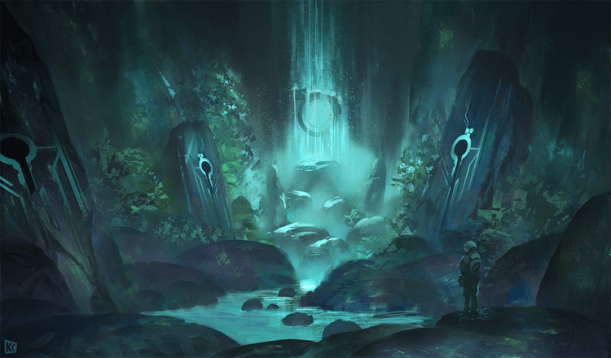
Untitled Concept Art by K04sk @ DeviantArt

New day, new blog.

I don’t plan to make a habit of it, but as I approach a new milestone (i.e. actually finishing the first draft on a book) it seemed like a good idea to start blogging under the name that will be on the cover of said book and create a site that’s a little more dedicated to writing. The blogging under the right name is pretty darn important. Someone pointed out to me that all the internet presence in the world is meaningless if nobody connects it with your product — in my case, my ‘product’ are the books I’m writing. So there you have it.

I have a bad track record about blogging consistently, and one can argue that it’s time I should instead be spending on finishing books. I’m going to try to work on both. We’ll see how it goes.